Your child knows what they want, but what happens when they cannot easily tell you? Perhaps they point instead of speaking, repeat familiar phrases, or become frustrated when others misunderstand them.
For parents, these moments can raise important questions: Is my child’s speech developing differently? How can I help them communicate? When should I seek professional support?
Autism communication and speech development can look different for every child. Some autistic children speak fluently, others use a few words, and some communicate primarily through gestures, pictures, or assistive technology.
Understanding these differences helps families focus on what matters most: giving children effective ways to express themselves.
How Does Autism Affect Communication Development?
Autism can influence how children understand language, express their needs, and interact with others.
Communication differences may involve:
- Developing spoken language at a different pace.
- Using gestures, sounds, or pictures.
- Understanding questions or instructions differently.
- Repeating words or phrases, known as echolalia.
- Finding conversations or social situations challenging.
Not every autistic child experiences these differences.
Some children develop advanced vocabularies while needing support with conversational communication. Others understand more language than they can express verbally.
Parents should recognize their child’s existing communication abilities rather than measuring progress solely by spoken words.
Early Signs of Speech and Communication Differences
Children develop communication skills at different rates. However, certain patterns may indicate that an assessment would be helpful.
These include limited gestures, difficulty communicating needs, differences in responding to spoken language, or delays in developing words and phrases.
A child might communicate by leading a parent toward an object rather than naming it.
Another child may repeat favourite phrases from videos to express an idea.
Neither behaviour automatically confirms autism or a speech disorder.
If concerns arise, parents can consult their healthcare provider or a registered speech-language pathologist.
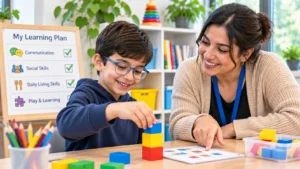
Families seeking individualized developmental support can also explore early intervention ABA therapy, which addresses communication, play, and everyday learning goals.
Speech Development vs. Communication Development
Speech involves producing spoken sounds and words, while communication includes exchanging information, expressing feelings, and making choices.
A child who does not speak may still communicate effectively through gestures, pictures, or technology.
Similarly, a child who speaks in complete sentences may need support understanding conversation or communicating emotions.
The goal of communication support should never be to force speech.
Instead, families and professionals should develop reliable methods that help children express their thoughts, preferences, boundaries, and needs.
How Early Intervention Supports Communication
Early intervention can provide individualized opportunities to develop practical communication skills.
Depending on the child’s needs, activities may focus on requesting help, making choices, understanding language, and participating in enjoyable interactions.
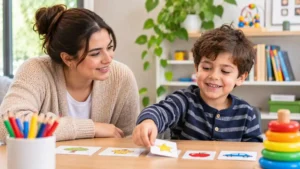
For example, a therapist might help a child communicate which activity they want using speech, gestures, or a picture board.
Learning should take place through meaningful experiences that respect the child’s interests.
A qualified speech-language pathologist can assess speech and language needs, recommend communication supports, and coordinate with other professionals.
Early intervention is useful beyond the preschool years, and support should remain available as children’s needs evolve.
How ABA Can Support Functional Communication
Applied Behaviour Analysis may help children develop meaningful communication skills through individualized teaching strategies.
Functional communication involves expressing a message in a way that others can understand.
Examples include:
- Requesting a preferred activity.
- Asking for help or a break.
- Expressing discomfort.
- Communicating choices.
- Saying no or refusing an activity.
A child who struggles with an unexpected transition might learn to request additional time through a gesture, picture, or spoken phrase.
The goal is to make communication easier, not simply to eliminate behaviour.
Advance Academy’s article on understanding behavioural interventions in autism therapy explains why identifying the needs behind behaviour matters.
What Is AAC for Autistic Children?
Augmentative and alternative communication (AAC) includes methods that supplement or replace spoken communication.
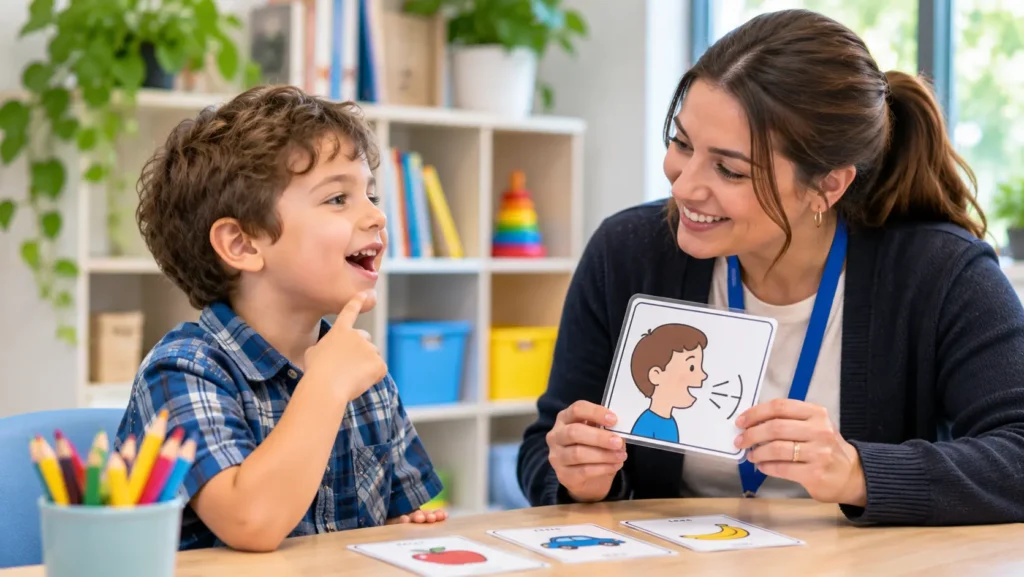
Common examples are picture boards, communication books, gestures, signs, and speech-generating devices.
AAC can help children express needs, share experiences, ask questions, and participate in daily activities.
Importantly, AAC does not prevent children from developing spoken language.
A speech-language pathologist can help determine which AAC options suit a child’s communication needs.
Children should have consistent access to their communication systems rather than being required to earn access.
Practical Communication Activities Parents Can Try
Parents can encourage communication naturally through enjoyable daily experiences.
Offer meaningful choices: Let your child select between two activities using their preferred communication method.
Follow their interests: Talk about or participate in activities your child already enjoys.
Allow processing time: Pause after communicating instead of immediately repeating instructions.
Model communication: Demonstrate words, gestures, or AAC symbols without demanding imitation.
Respond to all communication: Acknowledge requests, refusals, and expressions of discomfort.
These strategies should remain flexible and comfortable for your child.
For additional guidance, Advance Academy offers ABA parent coaching, helping caregivers incorporate individualized strategies into everyday routines.
When Should Parents Seek Professional Support?
Consider professional guidance if your child has difficulty communicating needs, experiences significant frustration, or loses previously developed communication skills.
A registered speech-language pathologist can assess speech, language, and AAC needs. A hearing assessment may also be appropriate.
Behaviour analysts can help develop functional communication goals within their professional scope.
Collaboration between professionals and families supports a more complete understanding of each child’s strengths.
Frequently Asked Questions
1. Do all autistic children experience speech delays?
No. Some autistic children develop speech typically or have advanced vocabulary, while others experience speech or language differences.
2. Can autistic children communicate without speaking?
Yes. Gestures, signs, pictures, writing, and AAC devices can all support meaningful communication.
3. Does AAC delay speech development?
No. Research indicates AAC does not prevent speech development and may support spoken communication for some children.
4. Can ABA therapy help with communication?
ABA-based interventions may support individualized functional communication goals, particularly when coordinated with speech-language professionals.
5. What communication activities can parents practise?
Offering choices, modelling communication, following interests, and responding to gestures can create natural learning opportunities.
6. When should my child see a speech-language pathologist?
Seek an assessment when communication or speech differences cause concern, especially if previously acquired skills are lost.
Helping Every Child Find Their Way to Communicate
Communication is more than spoken words. It helps children express preferences, develop connections, and participate meaningfully in everyday life.
At Advance Academy, individualized autism support focuses on practical communication, independence, and family participation.
Families can discuss their child’s communication needs with a qualified professional and explore appropriate developmental supports.
Every child deserves to be heard, whether through words, pictures, gestures, or technology.