
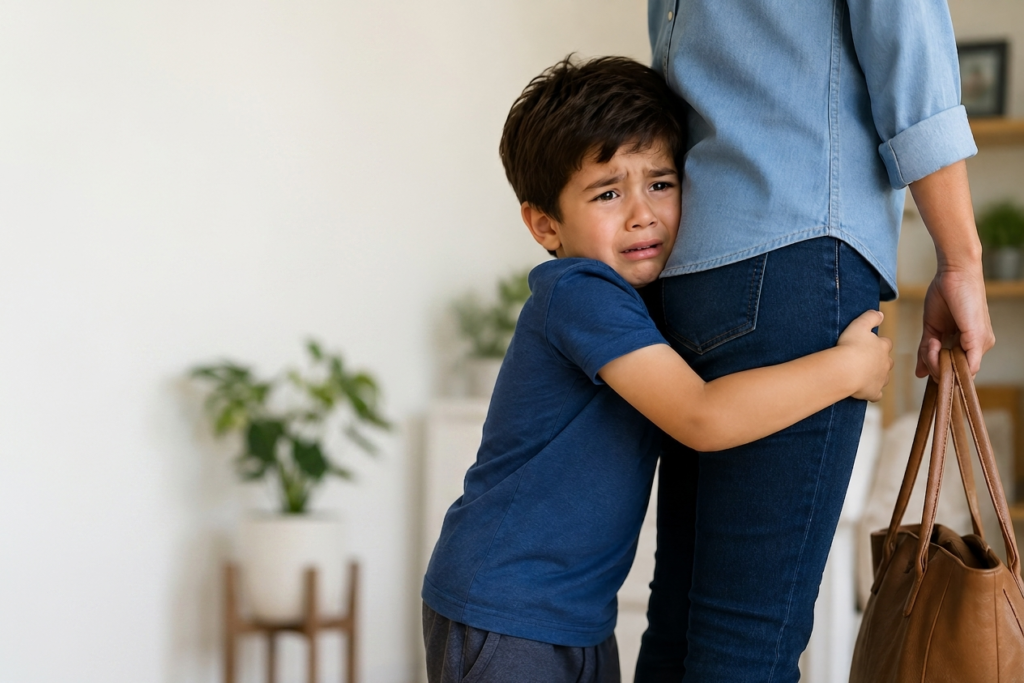
A few years into my work as a therapist, I met a mother named Priya and her son Aarav. Every school drop-off looked the same: Aarav wrapped his arms around her leg, refused to let go, and cried until the classroom door closed behind her. She wasn’t sure if this was “normal toddler stuff” or something tied to his autism diagnosis. It’s one of the most common questions I hear in my practice, and the honest answer is: separation anxiety is genuinely more common in autistic children, though it shows up differently for each one.
If this sounds familiar, take a breath. You’re not doing anything wrong, and your child isn’t either. Let’s walk through why this happens and what actually helps.
Why Autistic Children Experience Separation Anxiety More Intensely
Separation anxiety exists in many children, autistic or not. But for autistic kids, a few specific factors tend to make it stronger and longer lasting.
Predictability matters enormously. When a parent leaves, even for a short time, it can disrupt a child’s entire sense of order for the day. Combine that with sensory sensitivities, difficulty processing spoken reassurance, and trouble estimating time, and a simple goodbye can feel like true uncertainty rather than a quick errand.
There’s also the emotional piece. Many autistic children feel emotions deeply but don’t yet have the words to express them. A child who can’t say “I’m scared you won’t come back” might show it instead through crying, freezing, or clinging tightly.
Signs That Point to Separation Anxiety
In my sessions, these are the patterns I look for:
- Crying or meltdowns before a parent leaves, not just during
- Physically holding onto a caregiver’s clothing, hand, or leg
- Refusing to walk into school, daycare, or a therapy room
- Repeating questions like “when are you coming back?”
- Stomachaches or headaches before expected separations
- Trouble calming down even once the caregiver returns
A single hard morning doesn’t necessarily mean anxiety. It’s the repeated pattern across days and settings that tells the real story.
What Helps: Strategies I Recommend to Families
The encouraging part of this work is that separation anxiety responds well to steady, predictable support. Here’s where I usually start.
Create a short, consistent goodbye ritual. A specific phrase, a wave, or a hand squeeze gives your child something reliable to hold onto every single time.
Use visual timers or schedules. Many autistic children understand pictures and countdowns far better than verbal reassurance like “I’ll be back soon.”
Practice separations in small steps. Start with a minute in another room, then build up gradually. Trust grows through repetition, not through a single big leap.
Keep your own tone calm. Children pick up on a caregiver’s emotional state quickly. A steady voice during goodbyes tells your child, without words, that everything is okay.
Bring in structured professional support. This is often the turning point for the families I work with. Individualized, consistent ABA therapy at home across Canada allows a child to build coping tools in the exact environment where separations actually happen, which makes progress feel natural rather than forced.
For children who struggle most at drop-off, ABA therapy at daycare lets a therapist work with your child during the real moment of separation, rather than only in a clinic setting far removed from the problem.
If separation anxiety is one piece of a bigger developmental picture, connecting with early intervention services can help build a coordinated plan that covers home, school, and therapy together across Canada.
And if you’re located in the city, working with a local ABA therapy provider in Toronto makes it easier to access consistent, hands-on support close to home.
Progress Isn’t Always a Straight Line
Some weeks will feel like real progress. Others will feel like you’re back at square one. That’s a normal part of this process, not a sign that something is failing.
Aarav still has the occasional rough morning. But with a predictable goodbye routine and consistent therapeutic support, his drop-offs now take seconds instead of long, tearful minutes. That’s the kind of steady, real progress we work toward together, one small separation at a time.
Frequently Asked Questions
Is separation anxiety officially part of an autism diagnosis? No, it isn’t a core diagnostic criterion. But it appears frequently alongside autism because of challenges with change, communication, and sensory processing.
At what age does it usually improve? There’s no single timeline. Many children show real improvement within a few months of consistent support, while others continue working on it further into childhood.
Does ABA therapy actually help with separation anxiety? Yes. Structured, individualized ABA approaches teach children practical coping strategies and build confidence during separations, often practiced in the real settings where anxiety shows up.
Should I avoid separations if my child gets upset? It’s better not to. Avoiding separations altogether can reinforce the fear over time. Gradual, supported practice combined with a predictable routine tends to work far better long-term.
When is it time to seek professional help? If separation anxiety is affecting school attendance, sleep, or daily routines, it’s a good time to talk with a therapist or behavioral specialist for a personalized plan.